

How Many Wainwrights Are There? Everything You Need to Know About the Iconic 214.
The Wainwrights are Lake District fells featured in Alfred Wainwright’s famous Pictorial Guides to the Lakeland Fells. Completing them all has become one of Britain’s most iconic walking challenges.
When Alfred Wainwright compiled his walking guides in the 1950s and 60s, he probably had no idea they would inspire generations of walkers. These fells share no official status beyond their inclusion in his books. Wainwright picked them for their beauty, character, and role in the Lakeland landscape. He usually included only those over 1,000 ft (300 m).
In this guide, we answer the questions so many of you ask:
- What is a Wainwright?
- How many Wainwrights are there?
- Why are the Wainwrights so famous?
- What’s the best way to explore the Wainwrights?
What is a Wainwright?
A Wainwright is any fell in the Lake District listed in Alfred Wainwright’s seven-volume series, Pictorial Guide to the Lakeland Fells. This series was published from 1955 to 1966.
This world-famous guide features hand-drawn maps and pen-and-ink sketches alongside detailed walking routes. They have sold over two million copies worldwide.
Climbing them all is known as “Wainwright bagging”, and the fells exist nowhere else – you won’t find an official “Wainwright” outside Cumbria.
Today the Wainwright Society keeps his legacy alive by promoting his books and looking after the fells and countryside he loved so much.
How many Wainwrights are there?
There are 214 Wainwrights. They range from Scafell Pike (978m), the highest mountain in England, to the smaller Castle Crag (290m). This shows that Wainwright valued a fell’s character over its height.
Unlike Scotland’s Munros, which simply list the country’s tallest peaks, every fell here earned its place through personality, views and beautiful characteristics, rather than height alone.
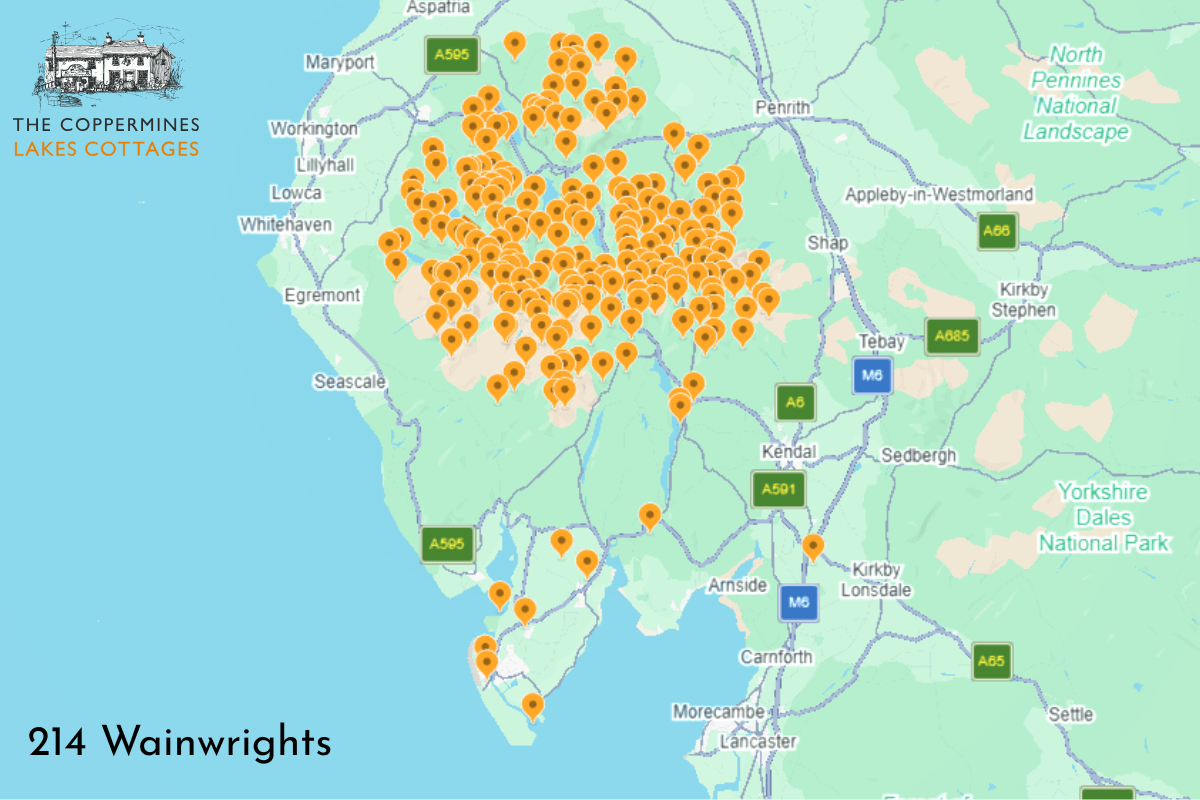
Wainwright couldn’t resist adding more to the original list, either. A supplementary Wainwright guide, The Outlying Fells of Lakeland, brought a further 116 summits into the fold, taking the wider Wainwright collection to 330 in total!
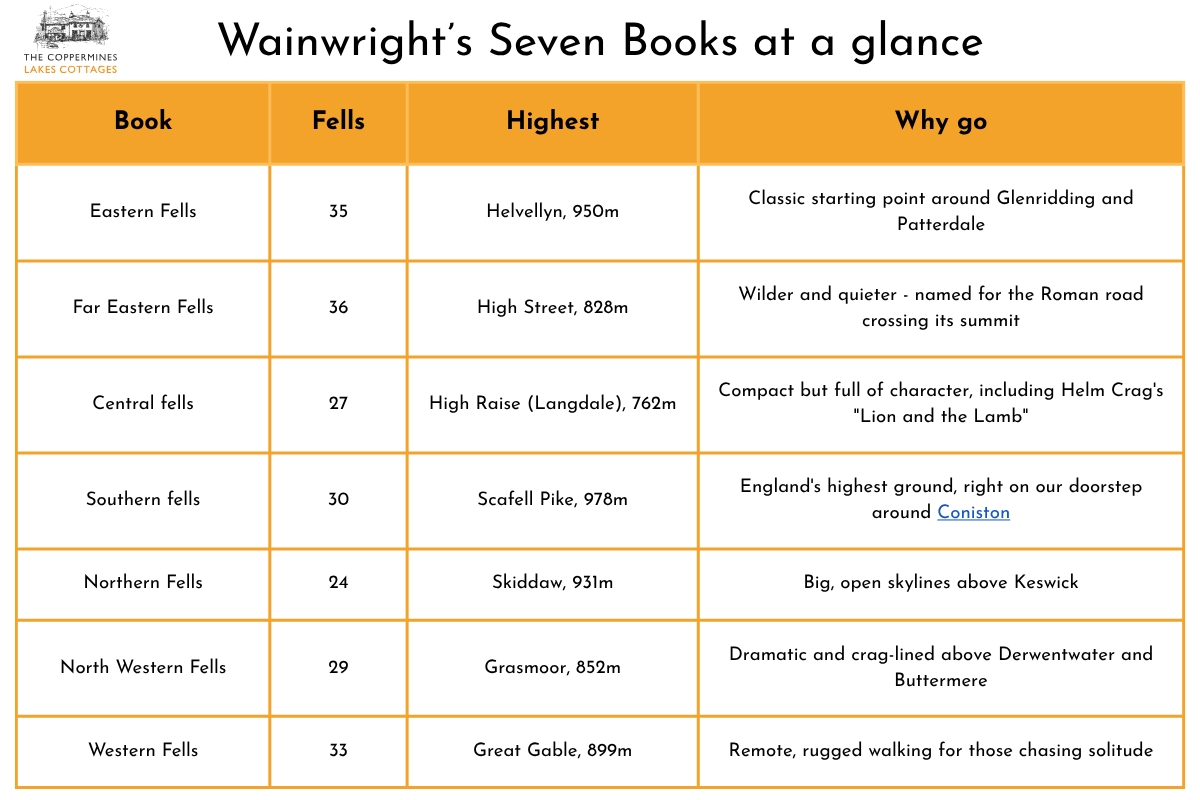
Wainwright split his 214 Wainwright fells across the Lake District into seven regional books, each with its own character:
Fancy dipping a toe in first? Our easy “cheat” Wainwrights for all abilities is the perfect way to bag your first few without a punishing climb.
Who was Alfred Wainwright?
Alfred Wainwright was an author, illustrator and lifelong walker. He spent 13 years lovingly crafting the guides that would define Lake District walking for generations.
Originally from Blackburn, his first view of the fells was from Orrest Head above Windermere in 1930. This sparked a love affair with the Lakes that lasted the rest of his life. He later settled in Kendal, working as Borough Treasurer until retirement.
The Pictorial Guides were a genuine labour of love, and Wainwright never actually intended to publish them. He was talked into it by friends and colleagues who knew what he’d created was special.
Related reading: Discover more in Who Was Alfred Wainwright & What Are His Walks. You can also follow his first footsteps yourself on the Orrest Head walk from Windermere.
How to bag Wainwrights
Most people don’t try to complete all 214 Wainwrights in one go. Instead, they tick them off gradually over years of Lake District walking, with many routes naturally taking in several fells in a single day.
To make the challenge more enjoyable:
- Link routes together where possible rather than climbing one fell at a time.
- Carry an Ordnance Survey map alongside your Wainwright guide and your phone.
- Mix easier and harder days to keep the challenge sustainable.
- Use the challenge as motivation to explore parts of the Lake District you might otherwise never visit.
- Record your progress with the Long Distance Walkers Association if you complete the full round.
Related reading: Check out our guide to bagging the most Wainwrights in one day for tried-and-tested routes.
How long does it take to complete all Wainwrights?
You can complete all the Wainwrights at your own pace. There’s no time limit, unlike the Bob Graham Round. Most walkers take a few years, while some may spend a lifetime.
The fastest time to climb all 214 Wainwrights is 5 days, 12 hours, and 14 minutes. American ultra-runner John Kelly set this record in 2022, and Guinness World Records confirmed it.
Not everyone needs a reason to keep coming back to the Lake District – but having a goal certainly helps.

Planning your Wainwright journey with a Coppermines Cottage stay
Your own Lake District cottage is the best base for exploring the Wainwrights. They give you a freedom hotels and B&Bs can’t match, with room for muddy boots and dogs, and often a private hot tub for tired legs.
Coppermines Cottages feature a large selection of Lake District cottages. Our homes provide beautiful bases from which to bag Wainwrights. Stay centrally in gorgeous Coniston, Hawkshead and Windermere, or Langdale, so you’re within easy reach of all the Wainwright fells.
Get in touch and let us find your perfect Wainwright bagging cottage today!


