

The Bob Graham Round: A Complete Guide to Lake District’s Ultimate Endurance Challenge
Visitors come to the stunning Lake District for relaxation, photography, history and adventure. For fell runners especially, this National Park is the perfect playground.
What better place, then, to try one of the UK’s most famous mountain challenges: the Bob Graham Round: 42 fells, 66 miles and around 27,000ft of ascent, all completed in a single sub-24-hour loop from Keswick.
Whether you’re training for a sub-24 attempt, planning to walk it over several days, or are just curious to know how anyone accomplishes this ultra feat, here’s your complete guide to the Bob Graham Round route, rules and records.
What is the Bob Graham Round?
The Bob Graham Round is a 66-mile fell running route over 42 Lake District peaks and roughly 27,000ft of ascent, started and finished at Moot Hall in Keswick within 24 hours.
It’s one of the most demanding one-day mountain challenges in the UK. Alongside the Paddy Buckley Round in Snowdonia and the Ramsay Round in the Scottish Highlands, it’s considered one of the “big three” – with only a handful of runners ever having completed all of them.
The Bob Graham route isn’t fixed to a single line on the map; runners choose their own path between summits, provided all 42 summits are touched within the 24-hour window.
To have a completion officially logged, you need to meet the criteria set by the Bob Graham 24 Hour Club, which keeps the record of every successful finisher, their time and any Bob Graham Round records set.
The Bob Graham Round 24 Hours Club: The rules
To join the club, you must complete the full round on foot, unsupported, inside 24 hours, and meet a list of strict conditions:
- Finish in under 24 hours
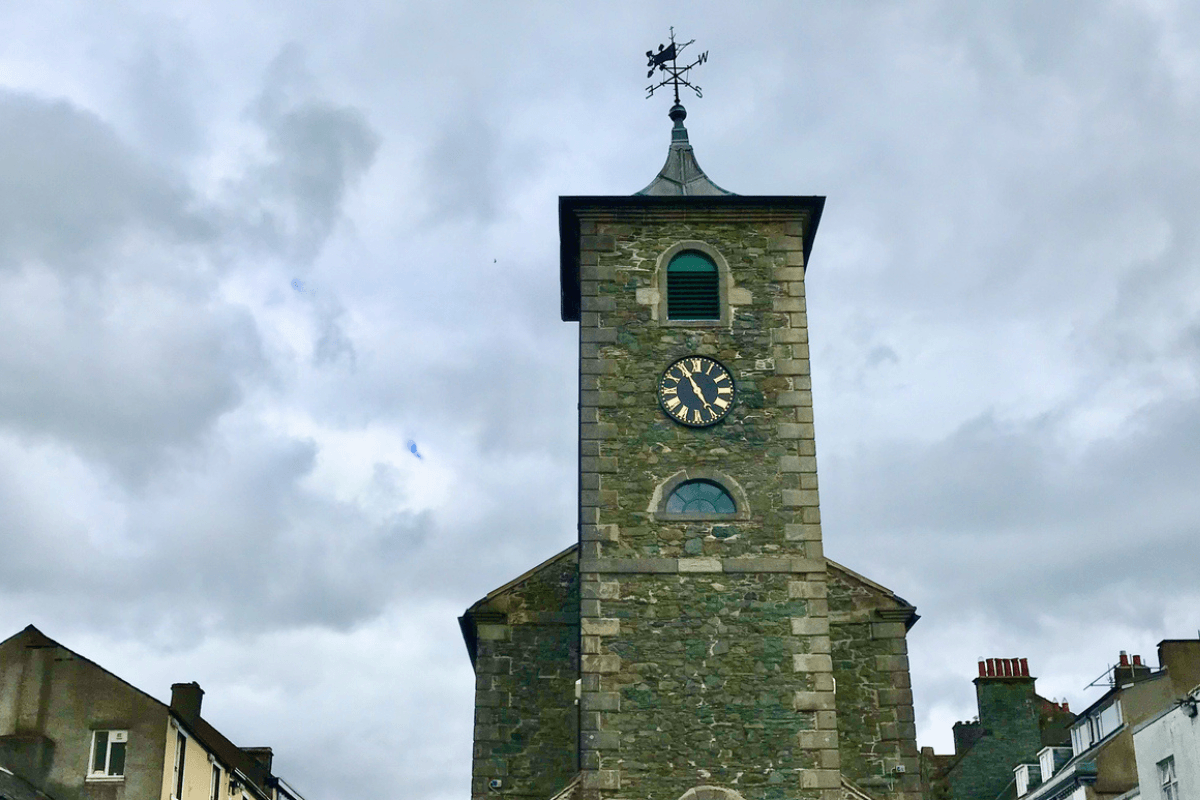
- Start and finish by touching the doors of Moot Hall, Keswick
- Cross all 42 mandatory summits
- Cover the entire route on foot
- Register your attempt in advance
- Be accompanied and witnessed at all times (pacers can change throughout)
- Submit a written report within 3 months of completion
The history: Bob Graham’s 1932 record
Keswick guest house owner Bob Graham set the template in 1932, running 42 fells on his 42nd birthday in 23 hours 39 minutes – and the record stood, unbeaten, for 28 years.
The idea began in 1904 with Dr Wakefield. But it was Bob Graham who made it famous and he did it in style, covering the fells in nothing more technical than a flannel shirt, canvas trainers and tennis shorts!
His original route included four peaks under 2,000ft; today’s official round swaps these for four summits over 2,000ft instead (more on that below.)
It wasn’t until 1960 that his once-unthinkable record was finally beaten.
The Bob Graham Round route
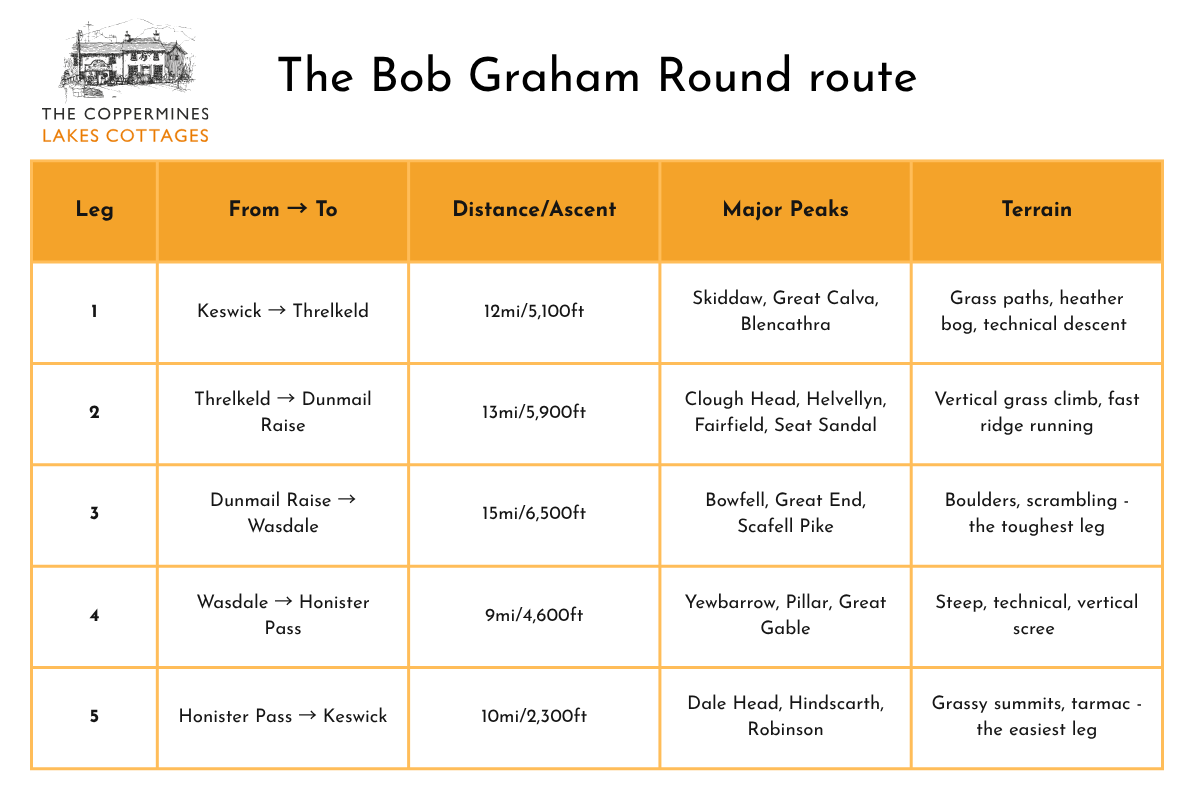
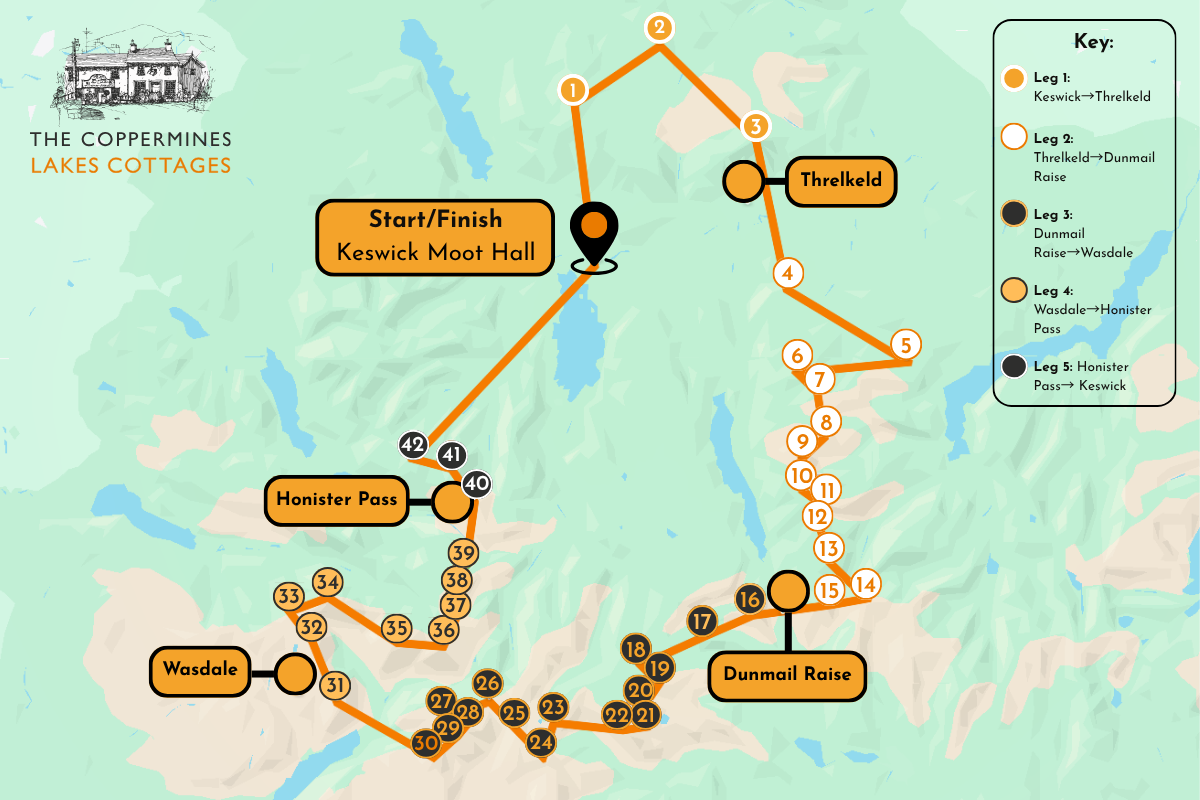
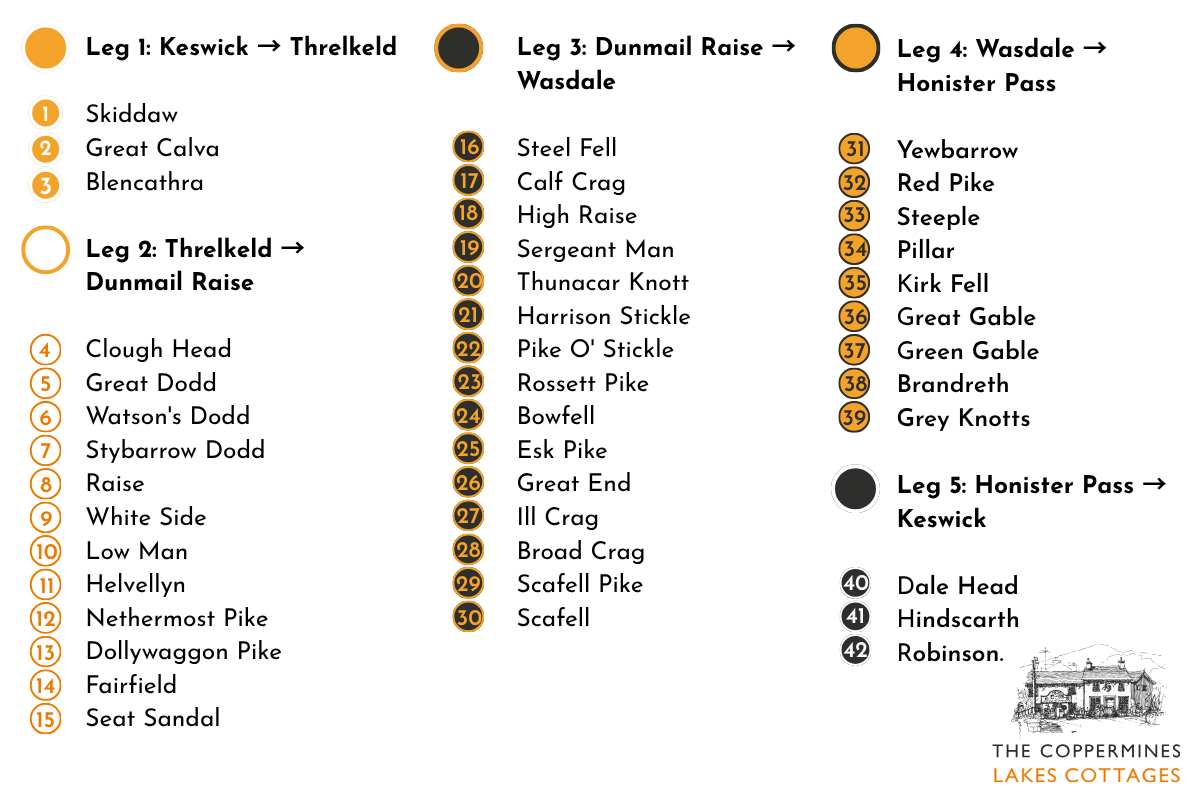
The Bob Graham Round is a circular route split into five legs, which can be completed either clockwise or anticlockwise. Most runners choose to tackle the technical, high-altitude Leg 3 overnight, when cooler temperatures can make the exposed terrain more comfortable. The table below outlines each leg:
The Bob Graham Round map below plots all 42 summits, in order along the route, colour-coded by leg:
Related reading: Want a taste of Leg 1 first? Skiddaw opens the round and is one of the most accessible major fells in the Lake District to walk in its own right. See our Skiddaw walk guide for a standalone route to the summit.
Who completes the Bob Graham round?
Taking on the Bob Graham Round is definitely a challenge for elite runners. And many of them will be forced to walk for some of the steeper sections. To have your name recorded by the Bob Graham Club, you must complete the challenge in under 24 hours and meet the strict criteria for a successful race.
If registering a sub-24-hour time isn’t your bag, you can still walk the Bob Graham Round. Many people enjoy the same 42 fells and 66 miles but over several days instead, wild camping or resting in the towns between.
To complete it, a good level of fitness is required, as well as solid navigation skills, sturdy walking boots, and plenty of provisions. It’s also always worth checking conditions with the Lake District’s mountain forecast before heading out.
Popular Bob Graham Round variations
Variations of the Bob Graham Round include the Double Bob Graham Round, the Winter Bob Graham Round, and the Frog Bob Graham Round. These super tough adaptations have risen to popularity in recent years. Let’s take a look at them in more detail:
- Double Bob Graham Round. Two loops back-to-back of the original, one clockwise, one anti-clockwise. First completed in 1977; the current record stands at an astonishing 42 hours 56 minutes, set by James Gibson in December 2025 – in winter, no less!
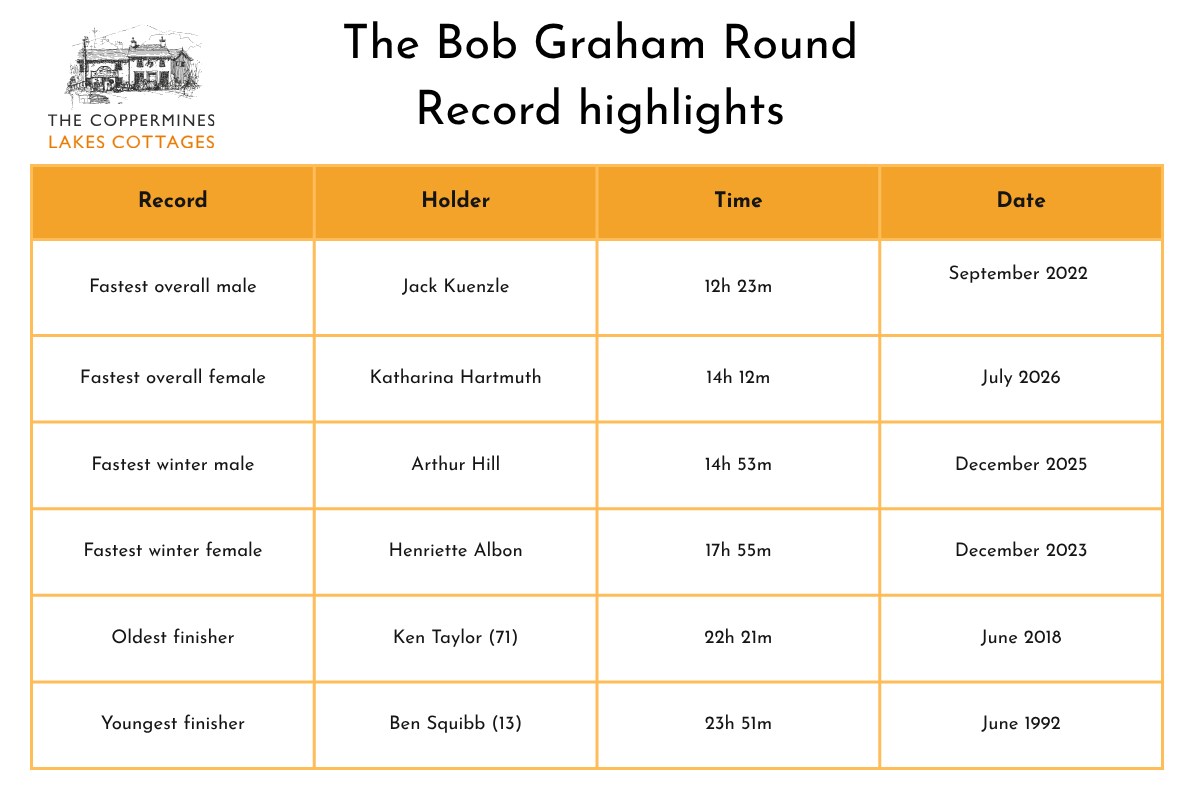
- Winter Bob Graham Round. The standard round, but with shorter daylight, colder temperatures and full winter conditions on the summits. By the end of 2025, 67 runners had achieved this phenomenal feat. The fastest time of this challenge, 14 hours 53 minutes, was set by Arthur Hill in December 2025.
- Frog Graham Round. Trades some of the ridge running in the original Bob Graham Round for water. There’s no official route, but, as well as roughly 40 miles of fell, runners must swim across Bassenthwaite Lake, Crummock Water, Buttermere and Derwentwater too.
Bob Graham Round record times and success rates
Over the last 50 years, over 3,000 people have completed the Bob Graham Round in 24 hours or less, although many more have enjoyed this epic journey.
With an average success rate of 50%, those who don’t manage their first attempt in 24 hours often come back for a second or third try.
Here are some Bob Graham Round record highlights:
Training and Preparation for the Bob Graham Round
Preparing for the Bob Graham Round involves months of dedicated hill running and hiking, registering your sub-24 attempt with the Bob Graham Club in advance, and careful planning around weather, safety and support.
With 27,000ft of ascent (nearly the height gain of climbing Everest!), this is no easy challenge, whether you’re running it or walking it. Most successful rounds are built on:
- Vertical training over flat mileage. Climbing and descending on rough terrain matters far more than running road miles. Many runners build toward big weekly ascent totals in the months beforehand.
- Reccying the route. Running each leg individually in advance builds pacing, navigation and confidence on technical ground, and helps you build a realistic schedule.
- Descent skills. The boulder fields and scree on Legs 3 and 4 are often where under-prepared attempts lose the most time.
- A support team. This includes pacers, navigators and road crew for food, dry kit and morale across all five legs, since you must be accompanied throughout.

For a deeper dive into training and pacing, Harvey Maps’ Bob Graham top tips and this 7-strategy training guide are both worth reading before you start planning.
If you’d rather watch than read, Running the Fells with Friends follows one runner’s full Bob Graham build-up and attempt – including his own verdict that it’s tougher than climbing Everest!
The Bob Graham Round: Running the Fells with Friends
Plan your Bob Graham Round base camp with a Coppermines Cottage
Whether you’re chasing a sub-24 time or simply soaking up the same 42 fells at your own pace, a comfortable, well-placed base makes all the difference. For training reccies beforehand and recovery afterwards.
Basing yourself somewhere central, like Coniston or the Langdale Valley, means you can reccy different legs across several visits before attempt day, while also enjoying the wider Lake District.
Coppermines’ Lake District cottages offer a cosy, private alternative to hotels. Browse our Mountain Cottages for a base close to the fells, or dog-friendly cottages if your support crew includes a dog. Start planning your Lake District adventure with Coppermines Cottages today!


